

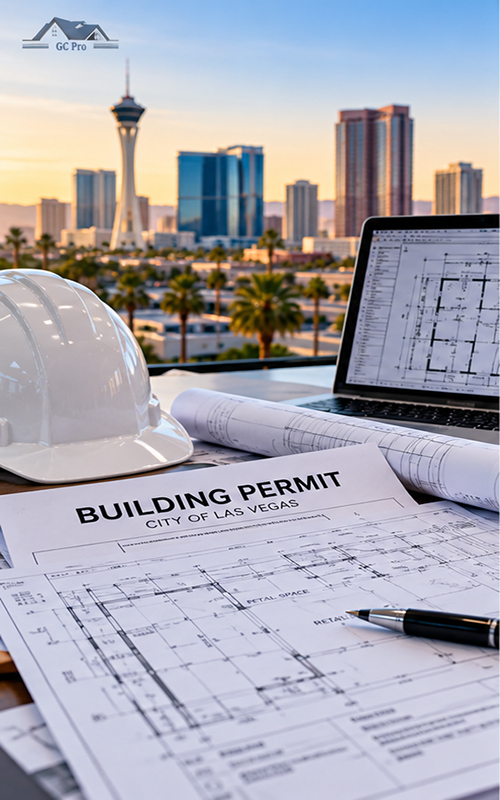
Commercial Construction Permits in Las Vegas: What Business Owners Need to Know
Planning a commercial construction project in Las Vegas? Understanding permits before construction begins can help you avoid costly delays, unexpected expenses, and problems opening your business.
Imagine finding the perfect location for your new business. The lease is signed, the design is ready, and you’re excited to begin construction.
Then you discover that the space needs additional approvals, updated architectural drawings, or changes to its electrical and fire protection systems.
Suddenly, your opening schedule becomes more complicated.
This is why commercial construction permitting should be part of the conversation from the beginning—not something you think about after hiring a construction crew.
At GC Pro Renovation, we help Las Vegas business owners, commercial tenants, and property owners navigate the construction process, including coordinating work around applicable permit and inspection requirements.
Whether you’re planning an office renovation, retail store build-out, restaurant improvement, or another commercial project, this guide explains what to consider before construction begins.
Do You Need a Permit for Commercial Construction in Las Vegas?
Many commercial construction projects require permits, especially when work involves changes to building systems, interior layouts, structural elements, or regulated safety features.
Examples include:
Commercial tenant improvements
New interior walls or layout modifications
Electrical system modifications
Plumbing improvements
HVAC changes
Structural alterations
Restaurant and commercial kitchen construction
Certain storefront modifications
Changes in building use or occupancy
New commercial buildings and additions
However, not every improvement requires the same permits.
The requirements depend on the project’s location, scope, existing building conditions, and applicable codes.
Before starting, review the official City of Las Vegas building permit information.
For projects involving multiple trades and construction phases, working with a commercial general contractor in Las Vegas can help organize the process.
City of Las Vegas vs. Clark County: Which Authority Issues Your Permit?
One of the most common sources of confusion is assuming every property with a Las Vegas mailing address falls under the City of Las Vegas.
That isn’t always true.
Some commercial properties are located within incorporated city limits, while others are in unincorporated Clark County.
The correct permitting authority is determined by the property’s jurisdiction, not simply its mailing address.
For example:
City of Las Vegas: Projects within city jurisdiction generally follow the city’s building and safety permitting procedures.
Unincorporated Clark County: Projects in unincorporated areas follow Clark County Department of Building & Fire Prevention requirements.
Henderson and North Las Vegas: These cities have their own permitting departments and procedures.
Before preparing your application, confirm which authority has jurisdiction over the property.
This can prevent applications from being submitted to the wrong department.
What Documents Are Needed for Commercial Construction Permits?
The required documents vary by project, but a commercial permit application may involve:
Building permit application
Site or location information
Existing and proposed floor plans
Architectural drawings
Structural engineering documents
Mechanical plans
Electrical plans
Plumbing plans
Fire protection information
Accessibility details
Occupancy and use information
Contractor licensing information
Landlord approvals, where required
Some projects require additional documentation or agency approvals.
For instance, a restaurant project may involve health-related approvals in addition to building and fire reviews.
The goal is to identify these requirements early enough to include them in the design and project schedule.
Commercial Tenant Improvement Permits
Tenant improvements are among the most common commercial construction projects in Las Vegas.
A tenant improvement, often called a TI, involves modifying a commercial space to meet the needs of a new or existing tenant.
Examples include converting an empty suite into an office, remodeling a retail store, or adapting an existing commercial unit for a different business.
Clark County’s tenant improvement permit guidance addresses plan submittals, occupancy information, fire protection, and other application requirements.
If you’re preparing a leased commercial space, explore our commercial tenant improvement services in Las Vegas.
Does a Small Tenant Improvement Need a Permit?
The answer depends on the work.
Painting or certain minor finish changes may be treated differently from projects involving electrical systems, plumbing, mechanical work, structural alterations, or regulated life-safety features.
Do not assume a project is permit-exempt because the space is small.
Confirm the requirements with the applicable building department before starting work.
Retail Store Construction Permits
Opening a retail store often involves more than installing shelving and painting walls.
A retail build-out may include changes to:
Customer entrances
Interior partitions
Electrical and lighting systems
Restrooms
Accessible routes
Fire protection systems
Storage and service areas
Even if the property was previously occupied by another retailer, the proposed use and construction scope may require review.
Our retail store build-out services in Las Vegas focus on preparing commercial retail spaces for new businesses and renovations.
Restaurant Construction Permits
Restaurants can involve additional complexity because of their mechanical, plumbing, electrical, food service, and fire protection requirements.
Depending on the project, plans may need to address commercial kitchen exhaust, grease management, equipment, plumbing fixtures, and fire suppression.
Restaurants may also require review or approval by the appropriate health authority.
A restaurant that previously operated in the space does not automatically mean every existing system is suitable for your new concept.
Review the building’s existing conditions before finalizing the design.
What Happens During the Commercial Permit Process?
Although every project is different, commercial construction permitting commonly follows these stages.
Step 1: Define the Construction Scope
Identify the work to be performed, the intended business use, and any proposed changes to the building.
Step 2: Evaluate Existing Conditions
Review the property to identify building systems, structural conditions, accessibility considerations, and other issues that may affect the project.
Step 3: Prepare Required Plans
Architects, engineers, and other qualified professionals prepare the documents required for the project.
Step 4: Submit the Permit Application
The application and plans are submitted to the appropriate jurisdiction.
Step 5: Plan Review
Reviewers evaluate the documents for applicable requirements. Corrections or additional information may be requested.
Step 6: Permit Issuance
When the application meets the applicable requirements and required fees and approvals are addressed, permits may be issued.
Step 7: Construction and Inspections
Construction proceeds according to the approved plans, with required inspections performed at appropriate stages.
Step 8: Final Approvals
The project may require final inspections, closeout documentation, and occupancy-related approvals before the space can be used.
What Causes Commercial Construction Permit Delays?
Common causes include:
Incomplete plans: Missing information can result in correction requests.
Changes during review: Major design changes may require revised submissions.
Unresolved building conditions: Existing electrical, mechanical, or structural limitations may affect the proposed design.
Landlord requirements: Shopping centers and commercial landlords may have separate approval procedures.
Specialty systems: Restaurants, medical facilities, and certain industrial uses can require additional coordination.
Incorrect jurisdiction: Filing with the wrong authority can delay the process before review even begins.
One of the most useful ways to reduce avoidable delays is to define the construction scope and identify necessary approvals before committing to an aggressive opening date.
How Long Does It Take to Get Commercial Construction Permits in Las Vegas?
There is no single timeline that applies to every commercial project.
Review times depend on the jurisdiction, application completeness, complexity, workload, required outside approvals, and number of correction cycles.
A relatively straightforward interior improvement can have a different review process from a restaurant conversion or a ground-up commercial building.
When developing your schedule, allow time for design, plan preparation, reviews, revisions, permit issuance, construction, inspections, and closeout.
Avoid promising customers or employees a fixed opening date until the project requirements and schedule are reasonably understood.
Why Hire a Commercial Contractor Before Applying for Permits?
A commercial contractor can help identify construction-related issues during the planning phase.
For example, a proposed store layout may affect electrical locations, HVAC distribution, walls, or accessible circulation routes.
Identifying these issues before construction can reduce unnecessary redesign and rework.
GC Pro Renovation provides commercial construction services in Las Vegas for offices, retail stores, restaurants, medical spaces, warehouses, and other commercial properties.
Our goal is to help coordinate construction activities with the project plans, budget, schedule, and applicable requirements.
Frequently Asked Questions
Can I start commercial construction before permits are issued?
Work that requires a permit generally should not begin until the appropriate authorization is issued. Confirm any exceptions or separately authorized early work with the permitting authority.
Do I need permits to remodel an existing office?
Possibly. Requirements depend on the scope, including whether electrical, plumbing, mechanical, structural, accessibility, or other regulated work is involved.
Do retail tenant improvements require permits?
Many do. The specific requirements depend on the proposed improvements and jurisdiction.
Who is responsible for obtaining commercial construction permits?
Responsibilities should be established in the construction agreement and coordinated with the property owner, design team, and contractor. Legal and licensing requirements also apply.
Does a permit mean I can immediately open my business?
Not necessarily. Final inspections, occupancy approvals, business licensing, and other agency requirements may still apply.
Does GC Pro Renovation serve Henderson and North Las Vegas?
GC Pro Renovation serves Las Vegas and surrounding communities, including Henderson and North Las Vegas.
Plan Your Commercial Construction Project With GC Pro Renovation
A successful commercial project begins before demolition or construction.
Understanding the permitting process, evaluating the property, and coordinating the project team can help you make better decisions about your schedule and investment.
If you’re planning a retail build-out, office renovation, tenant improvement, or commercial construction project in Las Vegas, GC Pro Renovation is ready to discuss your goals.
Call (702) 208-7974 to request a commercial construction consultation.
GC Pro Renovation
3141 W Post Rd, Las Vegas, NV 89118
Nevada Contractor License #0085854
This article provides general construction information, not a project-specific permit determination. Verify requirements with the applicable jurisdiction.
People also ask
A kitchen remodel in Las Vegas typically ranges from $15,000–$80,000+, depending on the scope of work, materials, and kitchen size. Minor refreshes (cabinet prefacing, new countertops) can start around $8,000–$15,000, while full custom kitchen renovations range from $40,000–$100,000 or more. GCPRO Renovation offers free in-home estimates to give you an accurate, no-surprise quote.
Most kitchen remodelling projects take 4–8 weeks from demolition to completion, depending on the scale. Custom cabinetry, special-order materials, and structural changes can extend timelines. GCPRO Renovation provides a clear project timeline before any work begins.
Yes depending on the scope, permits may be required for electrical work, plumbing changes, and structural modifications. GCPRO Renovation handles all permit acquisition and inspections as part of our renovation services.
Quartz is the most popular choice in 2026 due to its durability, low maintenance, and wide range of colours. Leathered granite and Denton are also trending for homeowners seeking a more unique, high-end look.
Absolutely. GCPRO Renovation offers comprehensive residential remodelling services including bathroom renovation, flooring installation, interior painting, and custom home renovation throughout the Las Vegas, NV area.
Latest Posts
Categories
Archive
Contact Us
[contact-form-7 id="a8b630b" title="Contact form 1"]