
Commercial Tenant Improvement Checklist Before Signing a Lease in Las Vegas
A commercial space can look perfect during a walkthrough and still require expensive construction before your business can open. Here’s what to check before you commit.
Finding a commercial property for your business is exciting.
Maybe you’ve discovered a storefront in a busy shopping center, an office suite near your customers, or a former restaurant that seems ideal for your new concept.
The rent fits your budget. The location looks promising. The landlord is ready to move forward.
But have you considered what it will cost to make the space usable for your business?
At GC Pro Renovation, we work with Las Vegas businesses and commercial property owners on tenant improvements, build-outs, and renovations.
One of the most important decisions you can make is to evaluate the construction requirements before signing a commercial lease.
This checklist will help you ask better questions, understand potential expenses, and avoid preventable surprises.
What Is a Commercial Tenant Improvement?
A commercial tenant improvement, or TI, is construction performed to adapt a commercial property to the needs of a tenant.
Tenant improvements may include:
- New interior walls
- Office partitions
- Retail store layouts
- Flooring and ceiling improvements
- Electrical and lighting modifications
- Plumbing changes
- HVAC modifications
- Restroom upgrades
- Reception and customer service areas
- Storage rooms
- Commercial kitchen improvements
- Accessibility-related work
The scope depends on the type of business, the condition of the property, and the approved plans.
Our commercial tenant improvement services in Las Vegas help businesses plan and coordinate improvements to existing commercial spaces.
1. Confirm the Property Can Legally Support Your Business
Before signing, verify that your intended use is allowed.
A commercial property being advertised as suitable for retail, office, or restaurant use does not automatically mean every business activity is permitted.
A change in use or occupancy can affect:
- Zoning requirements
- Building occupancy classifications
- Parking requirements
- Restroom requirements
- Fire protection
- Accessibility
- Building systems
- Permit approvals
For example, converting a general retail space into a restaurant can require substantially different infrastructure.
Contact the appropriate planning or building authority and obtain professional guidance before relying on the property’s advertised use.
2. Determine Whether the Space Is a Shell or Second-Generation Property
A shell space is generally an unfinished commercial unit that requires significant interior construction.
A second-generation space has been occupied previously and may contain usable improvements.
Shell Space
An unfinished space may need:
- Interior walls
- Electrical distribution
- HVAC systems or modifications
- Plumbing fixtures
- Restrooms
- Ceilings
- Flooring
- Lighting
- Fire protection work
A shell can offer flexibility, but construction costs may be substantial.
Second-Generation Space
A previously occupied commercial unit may already have usable building systems and interior finishes.
However, the existing layout may not work for your business.
It may also contain outdated, damaged, undersized, or unpermitted improvements.
Checklist question: What existing improvements can actually be reused, and what must be replaced?
3. Check Electrical Capacity
Electrical infrastructure is one of the most important items to evaluate.
Your business may need more power than the previous tenant.
Consider:
- Existing electrical service capacity
- Panel capacity and available circuits
- Equipment requirements
- Lighting
- Computers and technology
- Specialized machinery
- Commercial kitchen equipment
- Dedicated electrical circuits
An electrical upgrade can affect both cost and schedule.
Have a qualified professional assess whether the existing system can support the proposed use.
4. Evaluate the HVAC System
Las Vegas businesses depend on reliable heating, ventilation, and air conditioning.
A space may have an existing HVAC system, but that doesn’t mean it’s suitable for the new layout or business activity.
Questions to ask include:
- Is the existing equipment functional?
- Is its capacity appropriate?
- Will new partitions affect air distribution?
- Are ventilation changes needed?
- Who maintains and repairs the system?
- Does the lease make the tenant responsible for replacement?
HVAC modifications can become a significant part of a tenant improvement budget.
5. Review Plumbing and Restroom Requirements
The plumbing needs of a retail boutique are different from those of a restaurant, salon, or medical office.
Review the location and condition of:
- Water supply
- Drainage
- Existing restrooms
- Floor drains
- Sinks
- Water heaters
- Specialty plumbing connections
If your proposed layout requires moving plumbing fixtures, the construction scope can become more involved.
Restroom accessibility and occupancy requirements should also be evaluated.
6. Review Fire Protection and Life Safety
Fire and life-safety requirements are critical for commercial properties.
Depending on the space and intended use, construction may affect:
- Fire alarm systems
- Sprinkler systems
- Exit routes
- Emergency lighting
- Exit signage
- Occupant load
- Fire-rated assemblies
A new wall layout or occupancy change can affect existing systems.
Before signing, understand whether additional improvements or approvals may be required.
7. Check Accessibility Requirements
Commercial construction may involve requirements for accessible entrances, routes, restrooms, counters, and other building features.
An older property may need upgrades as part of a renovation or change in use.
The applicable requirements depend on the building and project.
Accessibility should be considered during feasibility planning rather than left until construction is underway.
8. Understand the Tenant Improvement Allowance
A tenant improvement allowance, commonly called a TI allowance, is an amount a landlord agrees to contribute toward qualifying improvements under the lease.
But the amount alone doesn’t tell you how useful the allowance will be.
Ask:
- How much is the allowance?
- Which expenses qualify?
- Are architectural and engineering fees included?
- Are permits included?
- Does it cover specialty equipment?
- Who pays costs above the allowance?
- When are funds released?
- Is reimbursement based on invoices or completed work?
- What happens if the allowance is not fully used?
- Who owns the improvements at the end of the lease?
The answers should be clearly documented in the lease.
For more information on construction budgeting, read our 2026 commercial tenant improvement cost guide for Las Vegas.
9. Understand the Landlord’s Construction Requirements
Many commercial landlords have specific rules governing construction.
These may involve:
- Approved working hours
- Insurance requirements
- Contractor qualifications
- Construction access
- Deliveries
- Waste removal
- Noise restrictions
- Protection of common areas
- Approval of drawings
- Storefront standards
- Final documentation
Shopping centers, mixed-use buildings, and large commercial properties may have additional requirements.
Ask for the landlord’s construction criteria before finalizing your plans.
10. Request a Preliminary Construction Evaluation
A walkthrough with an experienced commercial construction professional can reveal important questions before you commit to a property.
For example:
A former office may require major plumbing changes to become a salon.
A retail unit may need electrical upgrades for specialty equipment.
A restaurant space may have an existing kitchen exhaust system that requires inspection or replacement.
These conditions can significantly affect the project’s feasibility.
GC Pro Renovation provides commercial construction services in Las Vegas for businesses evaluating and improving commercial properties.
An early construction evaluation can help identify potential issues and support a more realistic budget.
11. Build a Complete Project Budget
The construction contract may represent only part of your opening investment.
Your budget may also need to include:
- Architectural plans
- Engineering
- Permits and inspections
- Construction labor and materials
- Specialty fixtures
- Equipment
- Signage
- Furniture
- Internet and technology
- Inventory
- Insurance
- Business licensing
- Contingency
Do not assume the landlord’s TI allowance covers all these expenses.
A Simple Budget Example
Suppose the anticipated project includes:
Expense
Illustrative amount
Construction
$180,000
Design and permits
$20,000
Contingency
$20,000
Total preliminary budget
$220,000
Landlord TI allowance
-$75,000
Estimated tenant share
$145,000
These figures are hypothetical and are not a GC Pro Renovation quote.
The purpose is to show why a tenant should calculate the full investment rather than focusing only on rent or the allowance.
12. Understand the Construction Timeline
A commercial lease can create financial obligations before the business begins generating revenue.
Discuss the following with your landlord and legal adviser:
- Lease commencement date
- Rent commencement date
- Construction access date
- Design and permitting periods
- Landlord approval deadlines
- Delivery conditions
- Construction completion expectations
- Delays outside the tenant’s control
If your store is scheduled to open in three months but design and approvals require substantial time, the schedule may not be realistic.
Construction planning should happen before promising an opening date.
13. Review Who Is Responsible for Unexpected Conditions
Existing buildings can contain surprises.
Examples include:
- Concealed damage
- Unusable building systems
- Undocumented alterations
- Code-related deficiencies
- Structural conditions
- Unexpected demolition requirements
The lease and construction agreement should establish how responsibilities and changes are handled.
A commercial real estate attorney can help evaluate lease language and risk allocation.
14. Ask About Future Expansion
Think beyond your opening day.
Will the space still work if your business grows?
Consider:
- Additional employee workstations
- More merchandise
- Increased storage
- Additional equipment
- Expanded customer areas
- Future electrical needs
- Future plumbing requirements
- Not every future improvement can be anticipated, but understanding likely growth can help you make better layout decisions.
15. Retail Store Leasing Considerations
Retail spaces deserve special attention because store layout and customer experience are closely connected.
Before signing a retail lease, consider:
- Visibility and storefront access
- Customer circulation
- Display areas
- Fitting rooms
- Checkout counters
- Inventory storage
- Accessible routes
- Lighting and electrical needs
- Signage restrictions
- Landlord construction criteria
If you’re opening a boutique, showroom, franchise, or specialty store, learn more about our retail store build-out services in Las Vegas.
Download-Free Commercial Lease Construction Checklist
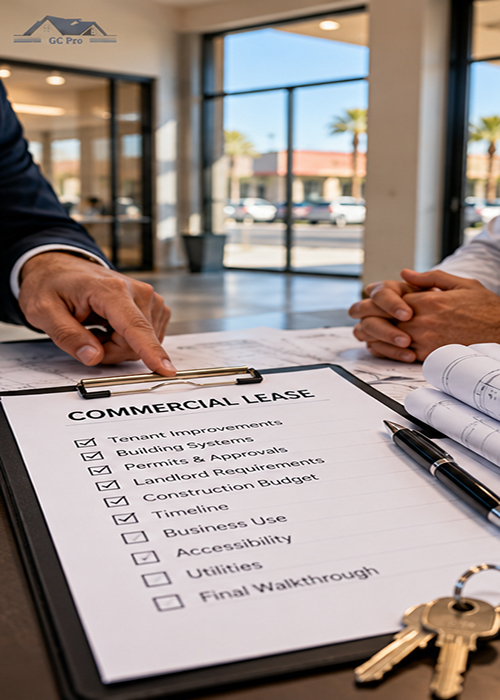
Before signing, make sure you can answer these questions:
- Is my intended business use allowed?
- Have I reviewed the existing building conditions?
- Is electrical capacity sufficient?
- Is the HVAC system suitable?
- Are plumbing and restrooms adequate?
- Have fire protection requirements been reviewed?
- Have accessibility considerations been evaluated?
- Do I understand the landlord’s TI allowance?
- Have I reviewed landlord construction rules?
- Have I received a preliminary construction budget?
- Does my timeline allow for design and permits?
- Are unexpected construction conditions addressed?
- Have I considered future business growth?
- Has a qualified professional reviewed the lease and property?
Frequently Asked Questions
Should I hire a contractor before signing a commercial lease?
An early contractor consultation can help identify construction considerations and potential costs before you make a major financial commitment.
What is a tenant improvement allowance?
It is a negotiated landlord contribution toward qualifying improvements, governed by the lease.
Can I negotiate the tenant improvement allowance?
It may be negotiable, depending on the property, market conditions, lease terms, and landlord.
Who pays for unexpected construction costs?
Responsibility depends on the lease, construction contract, and circumstances. These issues should be addressed before work begins.
Is an existing restaurant cheaper to convert into another restaurant?
Sometimes, but not always. Reusable systems can help, while outdated equipment, unsuitable layouts, or required upgrades can increase costs.
Does GC Pro Renovation provide tenant improvements in Las Vegas?
Yes. GC Pro Renovation provides commercial construction and tenant improvement services for businesses in the Las Vegas area.
Before You Sign, Understand What You’re Building
The best commercial location is not always the space with the lowest rent or the most attractive storefront.
It’s the space that can support your business at a total cost and schedule you understand.
Before signing a lease, evaluate the building, define the construction scope, and make sure the financial responsibilities are clear.
GC Pro Renovation helps Las Vegas businesses plan and coordinate commercial improvements.
Call (702) 208-7974 to discuss your tenant improvement project.
GC Pro Renovation
3141 W Post Rd, Las Vegas, NV 89118
Nevada Contractor License #0085854
This checklist is for general planning and does not replace legal, architectural, engineering, or project-specific construction advice.
People also ask
A kitchen remodel in Las Vegas typically ranges from $15,000–$80,000+, depending on the scope of work, materials, and kitchen size. Minor refreshes (cabinet prefacing, new countertops) can start around $8,000–$15,000, while full custom kitchen renovations range from $40,000–$100,000 or more. GCPRO Renovation offers free in-home estimates to give you an accurate, no-surprise quote.
Most kitchen remodelling projects take 4–8 weeks from demolition to completion, depending on the scale. Custom cabinetry, special-order materials, and structural changes can extend timelines. GCPRO Renovation provides a clear project timeline before any work begins.
Yes depending on the scope, permits may be required for electrical work, plumbing changes, and structural modifications. GCPRO Renovation handles all permit acquisition and inspections as part of our renovation services.
Quartz is the most popular choice in 2026 due to its durability, low maintenance, and wide range of colours. Leathered granite and Denton are also trending for homeowners seeking a more unique, high-end look.
Absolutely. GCPRO Renovation offers comprehensive residential remodelling services including bathroom renovation, flooring installation, interior painting, and custom home renovation throughout the Las Vegas, NV area.
Latest Posts
Categories
Archive
Contact Us
[contact-form-7 id="a8b630b" title="Contact form 1"]